
Design Improvements on LNG Carrier Cargo Handling Systems: Reliability, Safety, and Operational Flexibility by Design
GTT Inside N°35 | February 2026
Tech in Focus
DESIGN IMPROVEMENTS ON LNG CARRIER CARGO HANDLING SYSTEMS:
RELIABILITY, SAFETY, AND OPERATIONAL FLEXIBILITY BY DESIGN
At GTT, incremental engineering refinements are a catalyst for tangible value at sea. Building on operational feedback from vessels in service, we have developed a series of improvements to LNG Carrier (LNGC) cargo handling systems that strengthen reliability, safety and operational flexibility, without altering the overall architecture.
Three optimisations are now available to shipyards and ship-owners: an optimised pump tower design with tubular cable way; a top filling pipe designed to limit stratification and rollover risk; and rupture disks offering passive protection against accidental insulation‑space overpressure.
Optimised Pump Tower & Tubular Cable Ways: Robust Structure and Targeted Membrane Protection
The pump tower is subject to cryogenic temperatures, ship motions, cargo motions and dynamic loads. Its mechanical integrity remains central to safe cargo handling. In this latest evolution, GTT has simplified the tower by removing five strut stages, and increasing the pitch between stages from 1,840 mm to 3,000 mm. This optimisation reduces static and dynamic loads while maintaining the required strength and stiffness.
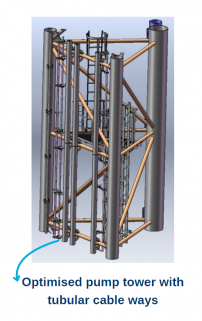 In parallel, GTT has replaced traditional bolted cable tray with tubular cableways, removing hundreds of bolts on each pump tower and reducing the risk of falling objects.
The purpose of this change is essential: to reduce the risk of damaging the membrane at the bottom of the tank due to dropped objects when the ship is at sea. This approach has already been implemented on container vessels and LNGCs equipped with membrane tanks.
Top Filling Pipe: Expanding the Operational Envelope
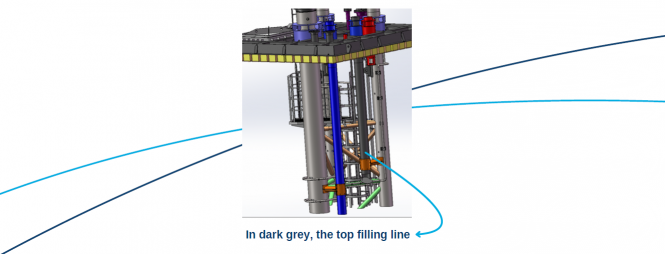
The top filling pipe introduces an additional top entry line, allowing operators to fill the tanks from the top when loading a new cargo which is heavier than the liquid heel remaining onboard. This capability is designed to save time during commercial operations at the loading terminal, while managing stratification and rollover risks, avoiding sudden boil‑off surges. The top filling line is typically needed in one or two cargo tanks and is widely used on FSRUs1, FLNGs2 and container vessels. With new commercial trends on the LNG shipping market, more and more partial loading and unloading operations are performed, which means that the top filling line now also makes sense on new LNGC designs.
Rupture Disks: Passive Safety for Insulation Spaces
Membrane damage from accidental overpressure in insulation spaces is rare, but can be severe. Such a dramatic event can only occur during the tank secondary barrier tightness test performed every five years, as safety valves are blanked during such a test.
Overpressure is not supposed to occur, and yet it has been experienced in the history of the LNGC industry. When it happens, consequences are severe as it typically takes several months to repair the damaged membrane. GTT therefore decided to look for a fail-safe solution, to make sure this can never happen again.
GTT’s solution involves two rupture disks per cargo tank (one per membrane). The disks remain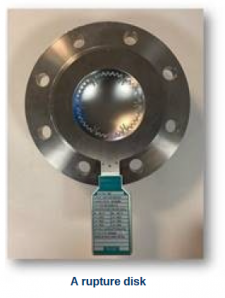 perfectly tight during normal operations and will not break when the safety valves are in service. The rupture disks do not replace the safety valves. Instead, they should be considered as complementary to the safety valves. Indeed, when the ship is in service, the insulation spaces will still be protected by these valves, as before, as they would open at a lower pressure compared to the rupture disks. Rupture disks can only break when safety valves are blanked, that is to say during the tank maintenance, and this is when accidents can occur.
Together, these improvements deliver more robust designs, safer maintenance, and more flexible and faster commercial operations. They embody GTT’s philosophy of practical innovation: careful engineering fed by operational feedback and targeted to real operational requirements.
------
1 Floating Storage and Regasification Unit
2 Floating Liquefied Natural Gas