Expanding the Applicability of Membrane FLNG Designs through Continuous Innovation
GTT Inside N°35 | February 2026
Pioneering Progress
EXPANDING THE APPLICABILITY OF MEMBRANE FLNG DESIGNS THROUGH CONTINUOUS INNOVATION
The global energy market is increasingly demanding flexible, robust, and cost-efficient LNG1 infrastructure. Thanks to decades of continuous R&D, GTT’s membrane technologies have become the benchmark for the most efficient and reliable containment solutions for FLNG2 applications. To date, four FLNG units equipped with GTT technologies are in operation worldwide, with three additional units currently under construction, including two featuring a 1-row architecture, demonstrating the maturity and strong industrial track record of these solutions.
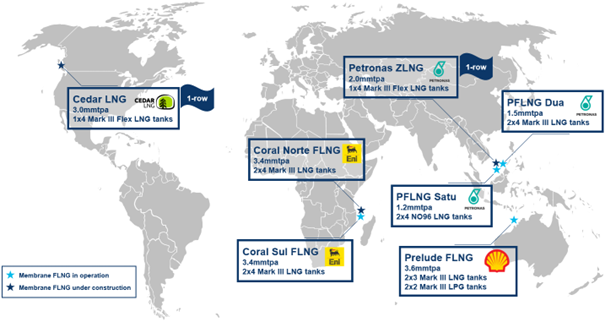
FLNG units equipped with GTT membrane technology
Recent design improvements further strengthen the leading position of GTT-equipped FLNGs across the full spectrum of metocean conditions, from nearshore to offshore.
One-Row Design: Now Applicable to a Broader Range of Projects
The transition from a traditional two-row configuration to a one-row concept delivers substantial structural and weight efficiencies, including savings of more than 10,000 m² of containment system surface area and approximately 200 tonnes of stainless steel associated with pump tower structures.
Historically, the one-row FLNG concept with four tanks was primarily suited for nearshore sites with mild sea states, typically below 1.5 metres of significant wave height. This limitation was primarily driven by increased sloshing loads at intermediate filling levels, combined with the large transverse breadth of tanks in one-row configurations, which can amplify the impact pressures on the containment system.
Leveraging higher levels of local reinforcements and adjusted tank dimensions with 5 metre lower chamfers, GTT has significantly enhanced the robustness of the tanks without filling limits.
This design evolution is also supported by extensive service feedback from more than 30 membrane-type FSRUs3 operating with large tank breadths at all filling levels and exposed to a wide range of sea states, providing valuable full-scale validation of sloshing behaviour and long-term structural performance.
As a result, the one-row FLNG design now offers expanded applicability and can be deployed on offshore sites with significant wave heights of up to 4 metres, providing a fully validated operating envelope. Beyond this range, the concept remains applicable, with site-specific assessments enabling optimised solutions tailored to more demanding metocean conditions.
For many projects, this opens the door to a highly competitive solution delivering an optimal balance between cost efficiency, operational flexibility, and technical performance.
Introducing the 1×3 Tank FLNG Concept: Reduced CAPEX with Full Storage Capacity
Building on the advantages of the one-row architecture, GTT has studied a new concept featuring only three elongated membrane tanks arranged in a single row. This 1×3 configuration maintains the same total storage capacity thanks to tanks up to 60-metre-long while offering additional value to stakeholders.
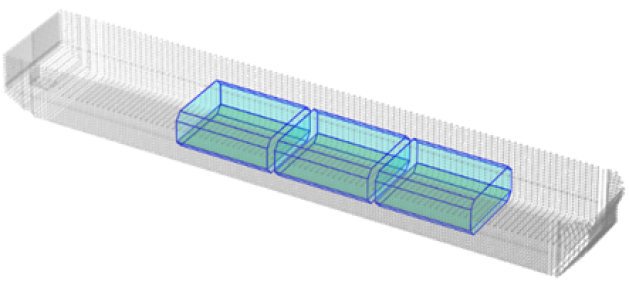
1x3 tank FLNG concept
Removing one tank - and its associated equipment and systems - directly subtracts an additional 2,000 m² of containment system and 50 tonnes of stainless steel.
The project schedule will also benefit from shorter construction time, especially considering that topside integration can proceed in parallel with membrane tank erection.
This concept is particularly suited for projects operating under mild metocean conditions, combining compactness, simplified arrangements, and reduced construction risks.
A Comprehensive Portfolio of Solutions for All FLNG Projects
Whether for LNG or LPG storage, and whether the project is located nearshore or offshore, GTT’s membrane technologies (NO96 and Mark III) offer a complete range of solutions adaptable to all metocean conditions.
By continuously advancing the design of membrane-based FLNGs, GTT ensures that owners, operators, and shipyards benefit from the most efficient, most flexible, and most competitive containment systems, tailored to the specific requirements of each project.
------
1 Liquefied Natural Gas
2 Floating Liquefied Natural Gas
3 Floating Storage and Regasification Unit