FLNG
The energy market requires flexibility when it comes to infrastructure. Well established over the recent years, FLNGs using GTT’s membrane technologies are today the global reference.
By continuous R&D, GTT keeps its leading position as provider of the most efficient liquefied gas containment systems for the offshore industry.
Hull Design for Long-Term On-Site Operations
Key advantages with membrane technology are optimised structural arrangements, leading to reduced floating unit motions. Functioning of the production systems is improved, and good access for inspection and maintenance is obtained.
Essentially, the structure can be designed with highest long-term fatigue resistance.
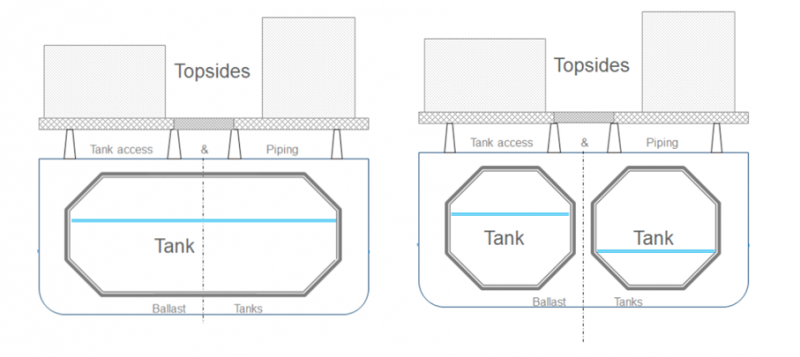
Membrane units provide a flat deck space for easy topside arrangement and a full occupation of the cargo hold, providing compactness and optimisation of the cargo storage capacity.
The tank arrangement is selected either as a one-row arrangement or a two-row arrangement, depending on the metocean conditions of the operation area. The two families of GTT’s technologies, NO96 or Mark III, may be used.
Ease of construction: faster, less risky planning
Unlike the competing technology (prismatic Type B), membrane technology benefits from significant ease of construction. Once the inner hull is completed, both the containment system and topside modules can be integrated in parallel, avoiding the need to consider the construction of the tank as part of the critical path.
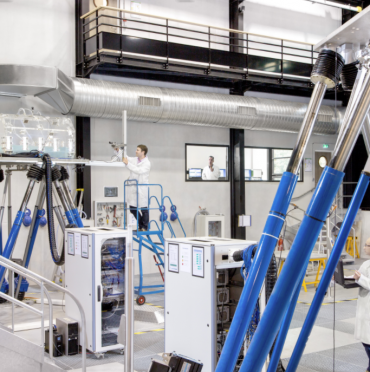
Sloshing Studies
Contrary to LNG carriers, which navigate under conventional filling levels, Offshore units must operate at all filling levels.
Sloshing activity is a subject that GTT addresses from the start of the project.
The preliminary studies (Pre-FEED & FEED) enable to establish the operational profile and identify the design (1 row, 2 rows, tank geometry) that provide the best answer to the environmental conditions observed on the site of operations.
It should be noticed that whatever the severity of the environmental conditions, calm or harsh sea conditions, a solution can always be identified with membrane tanks.
Design Improvements
One-row design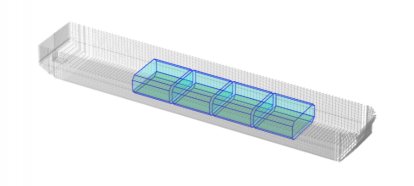
Initial design of membrane FLNG featured two rows of tanks, in order to cope with sloshing activity at intermediate filling levels (between 10% and 40% of tank height). In the middle of 2010s decade, the first LNG DF ultra large container vessels project (CMA-CGM series) led to a number of optimisations regarding LNG tank design and the maximum sloshing level it can sustain (upgraded material strength, tank shape adaptation).
Taking advantage of those improvements and the positive feedback at sea, GTT developed recently one-row FLNG design, which brings cost & schedule competitiveness as well as additional flexibility to the Client. This design were an immediate commercial success, with two FLNG one-row equipped with membrane tanks currently under construction.
2 x 3 tanks design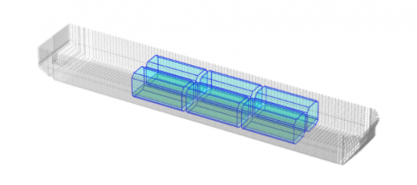
Another alternative to the initial 2 x 4 tanks design is to increase the length of tanks while keeping two rows of tanks. This would enable to have only 3 tanks by row, particularly applicable to projects with exposed site of operations where two-row designs would be more optimised than one-row.
Such design also brings many advantages, enabling a reduced building time and decreasing the CAPEX and the OPEX of the unit while keeping a similar operational flexibility.
Cargo Handling System
Boil-off rate (BOR) is guaranteed by GTT. Compared to competing technology, a better BOR simplifies the equipment to be considered.
Piping has been adapted for simultaneous operations, such as production, ship-to-ship transfer and maintenance.
One or several tanks can be temporarily decommissioned for maintenance while other tanks can be kept in normal operation. Pumps can be maintained without tank decommissioning by using retractable pumps.
Tank cool-down and warm-up times are shorter with membrane systems, reducing costs.
On-Site Maintenance
Like LNG Carriers, offshore units are subject to maintenance operations. Like in LNGC, Cargo Containment System (CCS) is continuously monitored, while the tanks are in service to avoid any downtime of the tank.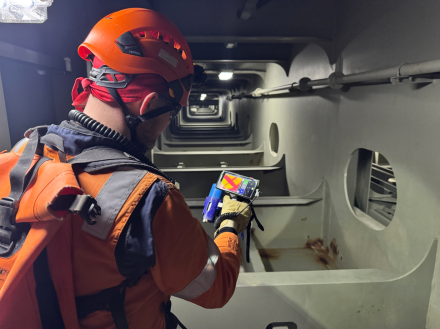
In addition, GTT Operations Department offers a turnkey solution dedicated for maintenance of FLNG membrane tanks (customised Risk based Inspection – RBI plan for LNG tanks):
- Development of the initial RBI for LNG tanks until approval by Class Society: data gathering, Risk assessment process and risk ranking, testing and inspection timeline.
- Standard and easy repair procedures following applicable offshore standards.
- Execution of RBI plan and follow-up with Class.
- Reassessment of RBI plan according to FLNG real life.
Owners & Operators receive GTT technical support at any time of FLNG life. During maintenance, GTT Operations Department acts as EPC, managing the subcontractors (testing and reparation companies). This customised Risk Based Inspection for LNG tanks can enable to extend the intervals of tank inspection safely.