Container vessel
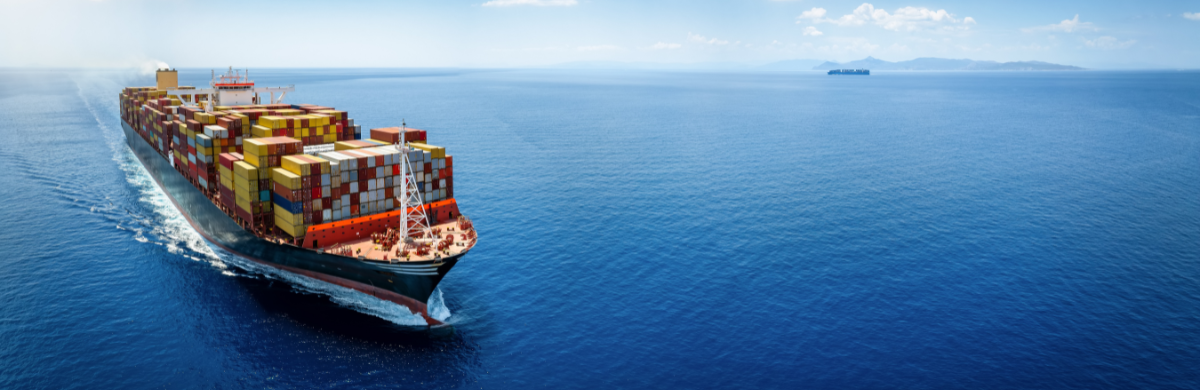
Container vessels are essential to commercial trading, travelling long distances on regular routes.
To comply with international regulations on worldwide shipping emissions and significantly reduce vessels’s air and greenhouse gas (GHG) emissions, LNG as fuel has emerged as the principal alternative fuel option being adopted today.
LNG as Fuel Benefits
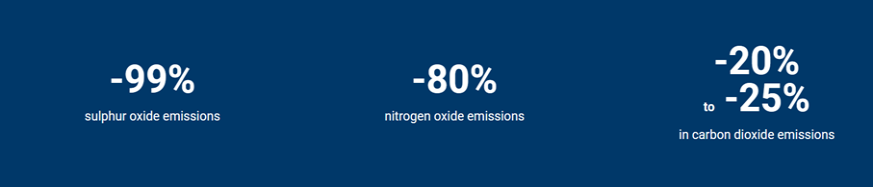
LNG-Fuelled Container Vessels
Accelerating the transition to low-carbon shipping
As environmental regulations become increasingly stringent, the maritime industry must adopt cleaner and more efficient propulsion solutions. Liquefied Natural Gas (LNG) has emerged as the leading alternative fuel, offering a reliable, readily available solution that meets both current and future requirements.
LNG-fuelled container vessels not only comply with emission standards, but also deliver strong operational performance and long-term competitiveness.
GTT expertise supporting LNG as fuel
With more than 60 years of expertise in membrane technologies, GTT delivers solutions recognised for their reliability and high safety standards.
GTT systems feature a double-barrier insulation design, protecting the vessel’s hull from cryogenic temperatures. They also integrate:
- Guaranteed boil-off gas (BOG) performance
- Continuous monitoring systems (pressure, temperature, gas concentration)
- End-to-end support across the LNG fuel system lifecycle, including training, commissioning, and emergency response services
Features and benefits of GTT technology for container vessels
GTT technologies provide tangible benefits for shipowners and operators:
Enhanced Cargo Capacity
- Space savings enabled by compact tank design, and optimised tank integration, notably with GTT CUBIQ™
- Additional TEU capacity, unlocking increased revenue potential
Long-Range Capability
Capability to perform long-distance voyages with a single bunkering, including major trade routes (e.g. Europe–Asia)
Reduced Emissions Impact
- Minimised Methane Slip
- Low boil-off rate (BOR)
- Recycool™ recondensing solution
- Compliance with upcoming environmental regulations
Cold Ironing Compliance
- Compatibility with cold ironing requirements
- Design pressure of 1.0 barg ensuring optimal holding time during port calls
Future Fuel Flexibility
- Ammonia (NH₃) readiness available
- Up to 14,000 m³ tank capacity without impacting LNG operations
GTT CUBIQ™: simplifying LNG fuel tank integration while optimising onboard space
GTT’s latest LNG fuel tank design, GTT CUBIQ™, has been developed for LNG-fuelled vessels, particularly container ships. Based on a cubic, chamfer-free geometry, it simplifies tank integration and installation while optimising onboard volume.
Leveraging GTT’s membrane containment expertise and advanced sloshing assessment, GTT CUBIQ™ increases LNG capacity, frees up additional space for hundred containers and supports a design pressure of up to 1 barg, providing enhanced operational flexibility during port stays and cold ironing operations.
Optimised Boil-Off Gas Management with Recycool™
Recycool™ is GTT’s innovative solution for efficient boil-off gas (BOG) management on LNG-fuelled container vessels.
By recovering cold energy from LNG vaporisation, it re-liquefies excess BOG, improving energy efficiency and reducing emissions. Its simple, compact design—without rotating machinery—ensures high reliability, low maintenance and optimised tank pressure management. Already proven at sea, Recycool™ enhances the overall performance of LNG-powered ships.
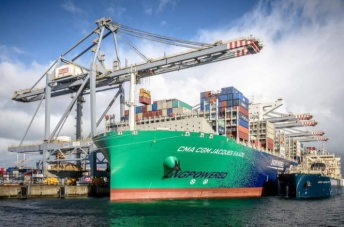 CMA CGM LNG-Powered fleet
GTT has collaborated with CMA CGM to equip several dozen of their container vessels with the GTT’s LNG tank.
Among them, CMA CGM’s flagship, the CMA CGM Jacques Saadé, 23,000 TEUs is powered by LNG, thanks to a 18,600 Mark III LNG fuel tank, enabling round trip capability Europe-Asia with only 1 bunkering operation while maximising cargo capacity.
Hapag-Loyd LNG fuel conversion (6,700m3) 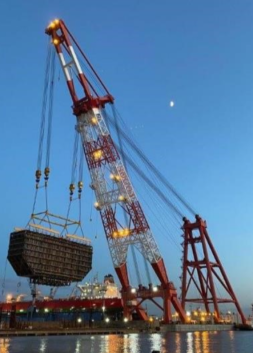
The 15,000 TEUs Brussels Express was converted to LNG fuel.
Retrofitted in HRDD shipyard, the exoskeleton equipped with a 6,700 m3 Mark III LNG tank was lifted inside the cargo hold before being welded to the vessel structure.
.
LNG-fuelled ships scanner