FSRU & FSU
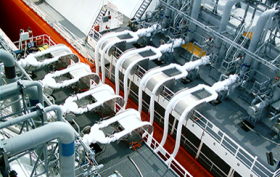
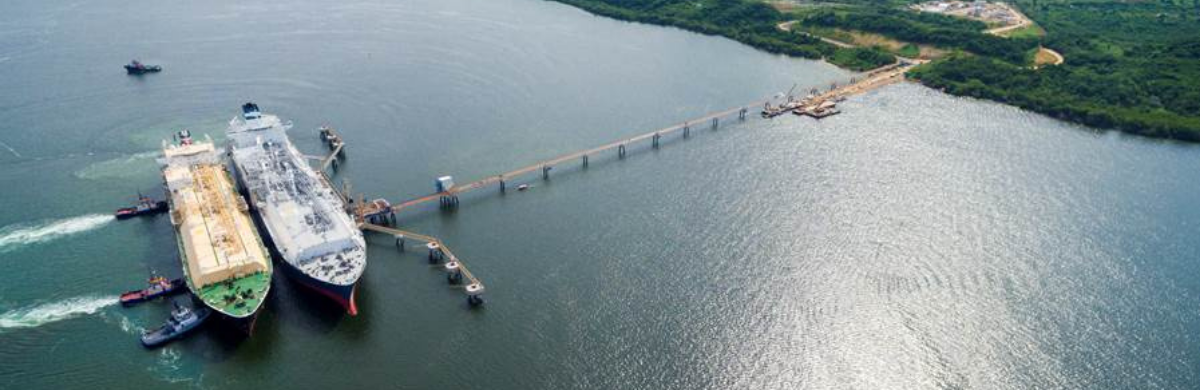
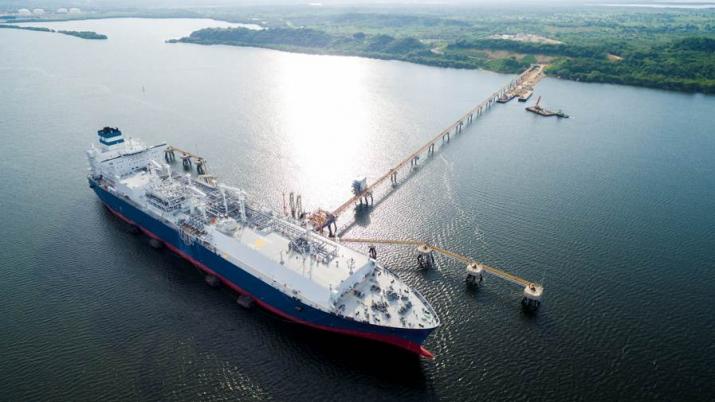
The energy market requires flexibility when it comes to infrastructure. Less expensive than onshore import terminals and faster to install, FSRUs (Floating Storage and Regasification Units) are a very flexible solution for importing countries. FSUs (Floating Storage Units) are similar but do not contain regasification capabilities. Instead, the FSU will feed its gas into a nearby regasification module.
As with LNG carriers, FSUs and FSRUs require tanks that minimise heat transfer. Membrane tanks designed by GTT provide low, guaranteed Boil-Off Rates (BOR) and use the available hull space most efficiently. Both GTT containment technology families, NO96 and Mark III, can be used to equip an FSRU or an FSU.
Hull Design for Long-Term On-Site Maintenance
Key advantages with membrane technology are excellent structural arrangements, leading to reduced floating unit motions by design. Functioning of the production systems is improved, and good access for inspection and maintenance is obtained.
Essentially, the structure can be designed with highest long-term fatigue resistance.
Membrane units provide a flat deck space for easy topside arrangement and a full occupation of the cargo hold, providing compactness and optimisation of the hull design.
The tank arrangement is selected either as a one-row arrangement or a two-row arrangement. The two families of GTT’s technologies, NO or Mark, may be used.
Sloshing Studies
While conventional LNG carriers typically operate either almost full or almost empty but never with tanks half-full, FSRUs and FSUs need to operate at any filling level. Therefore, the tanks have to be designed and reinforced to sustain higher sloshing loads occurring when the tanks are half-full.
GTT is involved from the early pre-project phase in the evaluation of the sloshing loads. These loads are site-specific and also depend on the mooring system (jetty moored, single point, or spread). Based on GTT’s assessment of the sloshing loads, GTT determines the optimum tank reinforcement layout and calculates the tank’s boil-off rate.
-----------------------------------------------
POWER SOLUTION
GTT has developed a digital automated risk analysis solution, called POWER (Prediction of Operational Windows to Enable Regas operations), to optimise the regasification operations of offshore units (FNLG or FSRU) and the transshipment of LNG between these units and LNG carriers in areas subject to difficult sea conditions.
Based on heading data, sloshing analysis and a three-day forecast, POWER provides better risk anticipation and a significant increase in ship-to-ship operations of offshore units exposed to rough sea conditions. It has been demonstrated that on certain offshore sites the POWER solution could increase operational windows up to 98% of on-site time, compared to 39% without the POWER solution
-----------------------------------------------
Advanced Engineering Services for FSRU Projects
GTT provides consultancy services and engineering studies to develop any kind of FS(R)U project, for either newbuildings or existing vessels
- LNG Ship-to-ship transfers – Hydraulic study (maximum achievable transfer rate calculation / Operation duration / Delivery pressure calculation / Equipment sizing).
- LNG carrier conversion to FSRU/FSU – Sloshing, MARVS pressure increase, Process and Instrumentation studies.
- Life extension – Extending the current service life or conversion for redeployment as FS(R)U to another location.
- LNG Vessel retrofit – For upgrade, modification and installation of equipment, such as Main or Auxiliary Engines, Regas Feed Pumps, Fuel Gas pump(s), Compressor(s), Vaporiser(s), etc.), Subcooler / Reliquefaction units, Top Filling(s), Disposal Unit, Pressure Relief Valves…
- Alternative Survey Plan (ASP) – FSRU tank maintenance optimisation.
- Emergency Departure – Study for FS(R)U in partial filling operations.
SHIP-TO-SHIP TRANSFER